Emrysia isn't just the studio name — it's a real, offline-first RF workbench I built and run on live work. When you hire the studio, this is the engine your deliverable comes out of. It's the proof of competence and the reason the report is more than an opinion.
The same workbench your deliverable comes out of. Watch it take a failing 2.4 GHz link and, in one move, foretell the rig that fixes it.
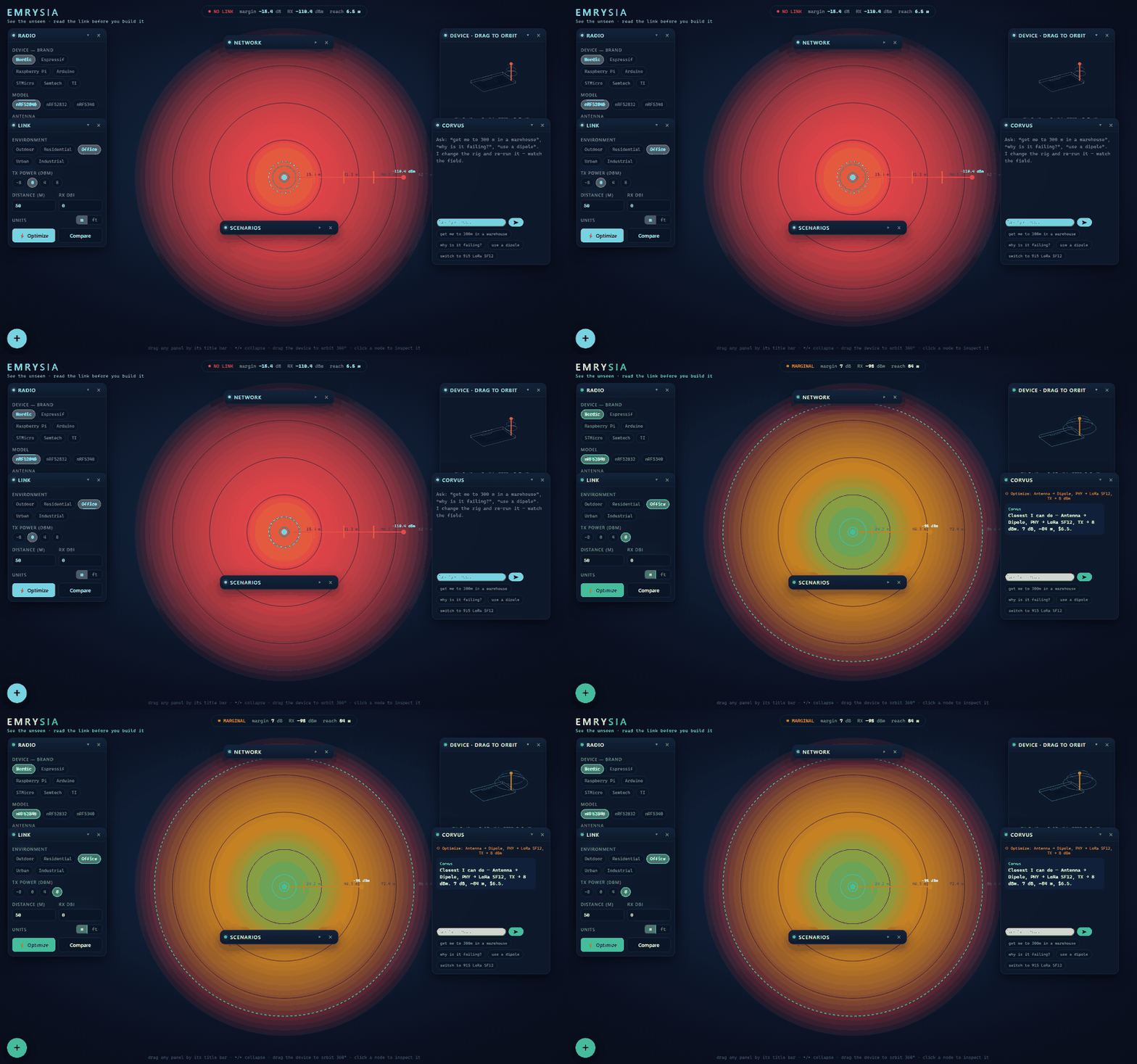
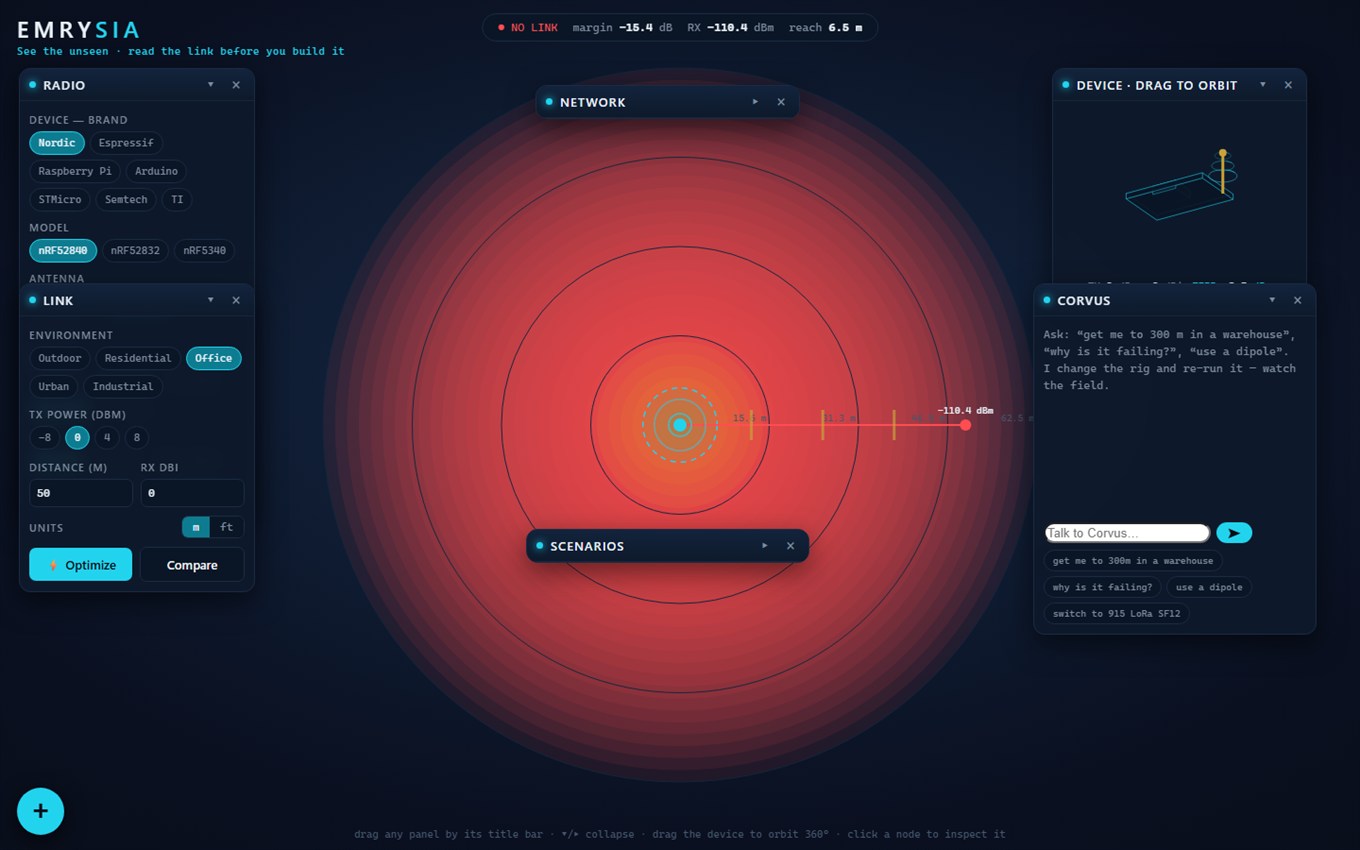
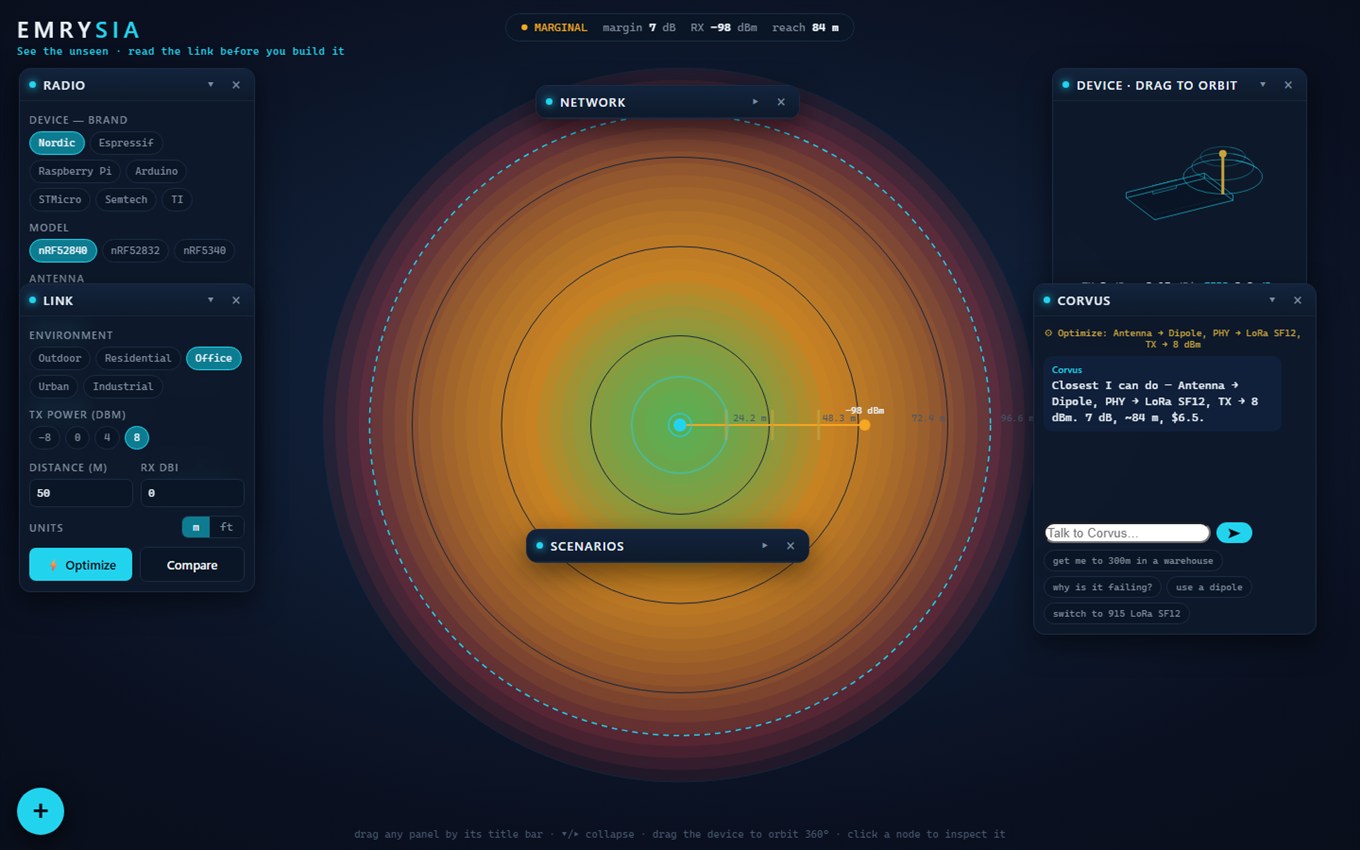
Every capability exists to put a number where there used to be a shrug.
Corrected multi-band Friis + log-distance path loss — no negative-path-loss unit bugs. Coverage rings and per-link margin in plain dB.
ITU-R P.526 single knife-edge diffraction along the real profile, plus a 3D view and a link cross-section. Hills break links here like they do in the field.
FCC / ETSI band legality, EIRP caps and duty-cycle limits, checked live — so the fix is legal where you actually deploy it.
Multi-node networks with comms-drop tracing. Faulted nodes glow red; click one and Corvus gives the verdict — cause first, then fix.
Paste Arduino / ESP-IDF / RPi / STM code. Wrong lines flagged red, corrections green, download the working firmware with a diff.
A blunt, dry assistant that reads the omens aloud. Runs on-device by default — no cloud dependency, no API key ever bundled in the app.
The sim canvas is the whole screen; every control is a draggable panel you summon and dismiss — Radio, Link, Device, Node, Network, Terrain, Spectrum, Corvus, Code. Minimal chrome, maximum field. Built for a phone in your hand at the base of a tower.
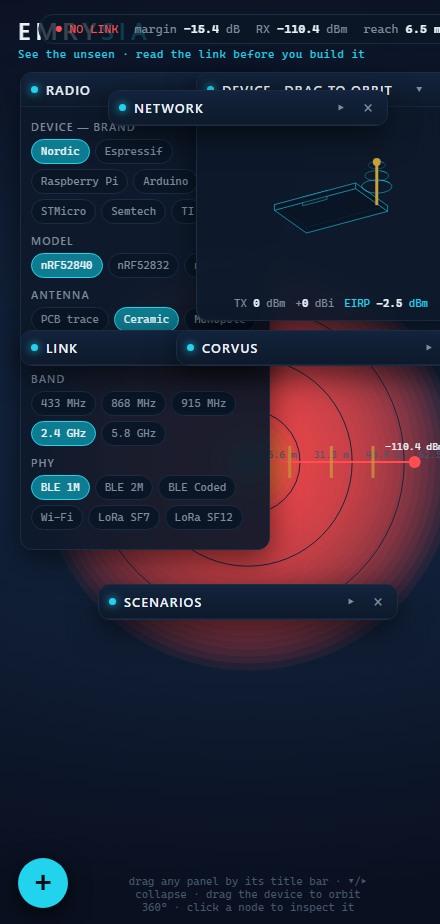
Real capture — the same workbench on a phone, offline, at the base of a tower.
The differentiator isn't the model on my screen — it's what you can hand to a client or a manufacturer at the end.
The reveal in plain language + the numbers behind it. Written to be read by a client, not just an RF engineer.
Your firmware, rewritten toward the fix, with a clean diff so every change is visible and reviewable.
Real, sourced parts — MCU, radio, antenna, matching — ready to drop into a quote or a fab order.
Per-node settings that make the model reproducible: bands, power, timing, placement.
Emrysia is the workbench I build on and run on live jobs. Hire the studio and you get its output on your deployment: the reveal, the fix, and the package to build from.